

ICE Airport Arrests Are Spreading — And One June Ruling Made Them Far More Dangerous
🚨 ENFORCEMENT ALERT: ICE IS WORKING U.S. AIRPORTS — AND EXPEDITED REMOVAL IS NOW NATIONWIDE 🚨

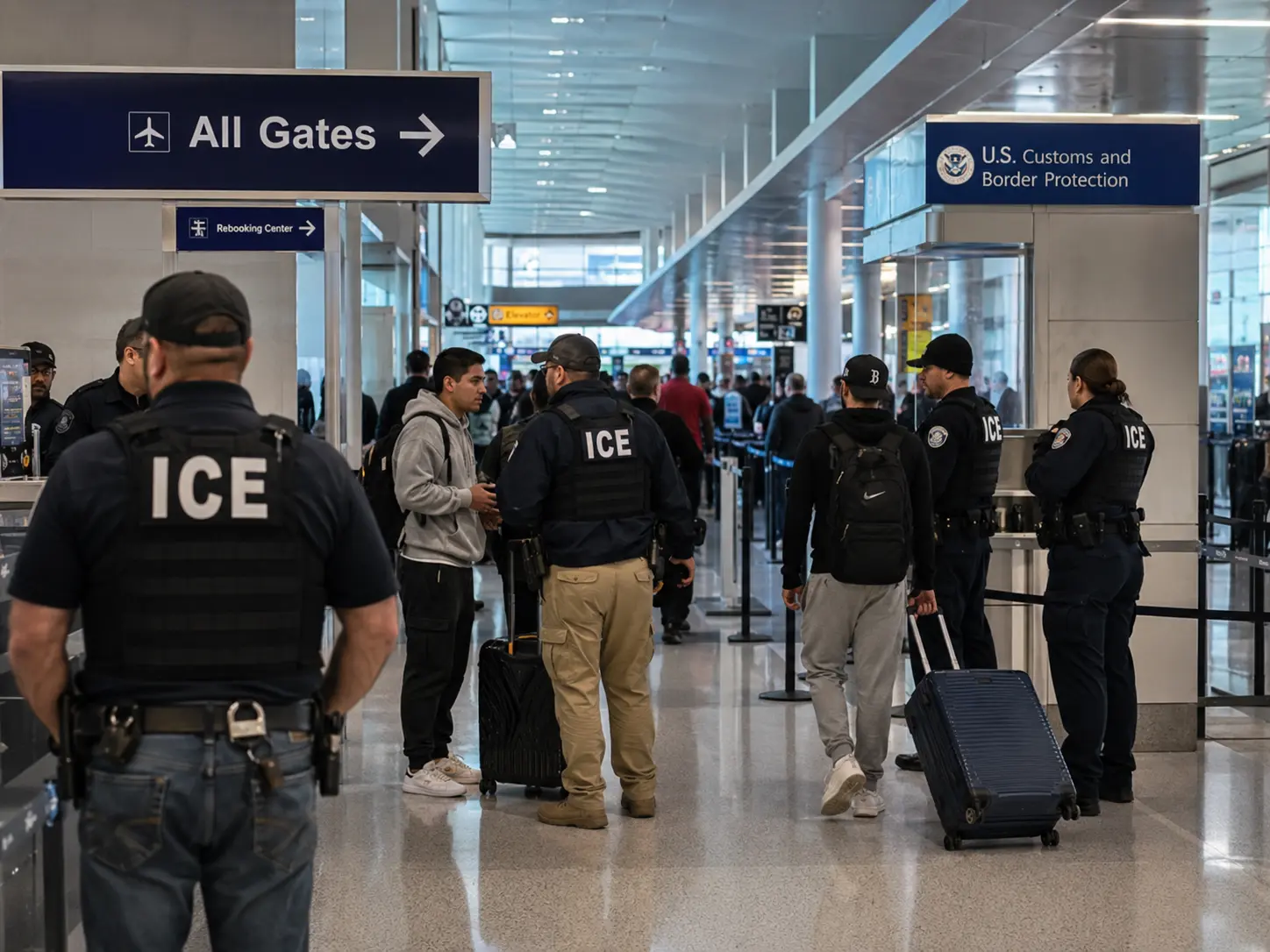
ICE airport arrests are no longer reserved for people with deportation orders. Through July and early August 2026, arrests were reported at more than a dozen U.S. airports, and the people detained included workers waiting on visa extensions and spouses in the middle of a marriage-based green card case.
Here is the part most coverage has missed. On June 23, 2026, a federal appeals court allowed the administration's nationwide expansion of expedited removal to take effect. Airport enforcement is the tactic. Expedited removal is what makes it so costly if it goes wrong.
We are not writing this to frighten you. We are writing it because the difference between a bad outcome and a manageable one now comes down to what you carry, what you say, and how fast someone calls a lawyer.

Why the Airport Became the New Enforcement Site
An airport gives the government something a home visit or a workplace raid never could: advance notice. Your name is attached to an itinerary days before you travel, which means the agency knows the date, the terminal, and the destination — and knows you will walk through a screening checkpoint to get there.
A 2025 information-sharing memorandum between ICE and TSA is what turned that itinerary data into an enforcement tool. Reporting this summer tied more than 800 arrests to that cooperation, and the flagged list has grown well past people with final removal orders.
Who is on it now:
 Marriage-based applicants mid-process. People waiting on an interview or a decision on a case filed by a U.S. citizen spouse.
Professionals waiting on an extension. A visa that lapsed while USCIS holds the extension petition is now treated as an overstay.
People holding a work permit the government itself issued. An unexpired EAD has not prevented arrest.
Long-settled people with old lapses. Former students, au pairs, and visitors with no criminal record and years of quiet life here.
TSA and ICE Are Not the Same Agency — Know Who Is Talking to You
This distinction is worth more than it sounds, because it changes what you are obligated to do. TSA screens for security. Its job at the checkpoint is to confirm you are who your boarding pass says you are — not to determine your immigration status. In California and other states with limits on state and local cooperation, TSA screeners have no business asking about your status at all.
ICE enforces immigration law, and its agents can approach you anywhere in the terminal, including past security, at the gate, or on the jet bridge when you land. Unlike CBP at a port of entry, ICE does not carry broad border search authority into the domestic terminal — agents generally need a warrant to search your bags.
 A domestic flight is still a flight. You do not have to cross a border to appear on a list. Several arrests this summer happened on trips entirely inside the United States.
Both ends of the trip count. One traveler this summer boarded in one city and was detained on arrival in another.
Silence has a cost, and it is usually worth paying. Declining to answer may mean missing your flight. It also may be the reason you are not signing paperwork in a detention facility that evening.
Three Terms That Decide Your Case: Status, Authorized Stay, Unlawful Presence
Most people use these interchangeably. Immigration law does not, and the gap between them is where a great many defenses live.
Lawful status means you hold a category — H-1B, F-1, lawful permanent resident. A period of authorized stay is broader: the government permits your presence even though you hold no category, which is the situation of most people with a pending application. Unlawful presence is the narrow, technical clock that triggers the threeand ten-year bars on returning — and it does not run in many of the situations
people assume it does.
Your visa is a fourth thing entirely. It is a travel document that governs asking for admission at the border. The date in your passport is not the date your permission to be here ended — that comes from your I-94 record, which you can pull up online in two minutes and which most people have never looked at.
 A pending Form I-485 generally places you in a period of authorized stay while USCIS decides.
A timely-filed extension or change of status can protect you while the petition sits in a queue.
A valid EAD or advance parole is evidence the government granted you something — carry it.
TPS, DACA, a pending asylum claim, or a U or T petition each carry protections of their own.
None of this makes you immune to arrest. All of it can make the difference in whether you are released, and how your case ends.
“An expired visa is not a verdict. Detention is not deportation. The people who come
through this well are almost always the ones who knew what was in their own file
before anyone asked them.” — Goldstein Immigration Lawyers, Los Angeles
The June 2026 Ruling That Changed the Math
Expedited removal used to be a border tool: it applied to people caught within roughly two weeks and 100 miles of entry. A January 2026 executive order stripped out those geographic and time limits, litigation followed, and on June 23, 2026, the D.C. Circuit allowed the expansion to proceed in a 2-1 decision.
The practical result is stark. Expedited removal skips the immigration judge. There is no bond hearing, no chance to gather evidence over months, no courtroom where your spouse testifies about your marriage.
There is a statutory protection: expedited removal generally does not reach someone who can show two years of continuous presence in the United States. But an officer is not required to tell you that protection exists.
You have to raise it yourself, immediately, and be able to prove it. That is why what lives in your bag matters as much as what lives in your file.
If you fear returning to your home country, say so — clearly, out loud, and more than once. A stated fear of return triggers a screening interview instead of a straight removal, and it is one of the few doors that stays open in this process.
What TSA Actually Accepts If You Are Not a U.S. Citizen
A surprising number of people skip trips they were entitled to take because they believe they cannot board without a REAL ID. You can. TSA is verifying identity, not status, and it accepts several documents non-citizens commonly hold.
A valid, unexpired foreign passport. Fully acceptable for domestic flights on its own.
Permanent Resident Card. The green card works as identification at the checkpoint.
Employment Authorization Document (Form I-766). Your work permit is an accepted ID.
Border crossing card or a DHS trusted traveler card. Global Entry, NEXUS, SENTRI, and FAST all qualify.
➢ What does not work alone: a visa stamp or an I-94 printout. Keep them with you as proof of your immigration situation — just not as your checkpoint ID.
Important: being able to board and being ready to travel are two different questions. Read the next section before you buy the ticket.
Build Your Travel Folder Before You Book
Bring copies, not originals, and keep them on your person rather than in checked luggage. Everything below exists to answer a question an officer may ask you exactly once.
Proof of what you have pending. Every USCIS receipt notice (Form I-797), your EAD, your advance parole, your I-94 printout.
Proof of two years of continuous presence. A signed lease, dated mail with your address, pay stubs, school or clinic records, utility bills. Boring paper, enormous value.
Form G-28 if an attorney represents you. Handing it over immediately tells the officer you are represented.
Your attorney's number on paper, memorized if possible. Phones get taken. A card in your wallet does not.
A written family plan. Who collects the children, who can reach the bank account, who holds the copies of your file. Give one person outside your household a full set.
Nothing false, ever. A borrowed or altered document turns a winnable case into an unwinnable one in a single afternoon.
If ICE Approaches You in the Terminal
Fear makes people explain themselves. Explaining is what builds the government's file. Six moves, in order:
➢ Ask one question: “Am I free to leave?” If yes, walk away calmly. If no, you are detained and the rest of this list applies.
➢ Say the sentence: “I want to speak to my lawyer. I choose to remain silent.” Then stop talking, including small talk.
➢ Hand over documents, not explanations. Your G-28, your receipt notices, your EAD. Let the paper speak.
➢ State your two years of presence and any fear of return. Say both out loud even if no one asks.
➢ Sign nothing. A voluntary departure or stipulated removal form can surrender rights that no lawyer can recover later.
➢ Never lie, and never run. Silence is protected. False statements and flight create new problems on top of the old one.
The First 24 Hours After Someone Is Detained
Detained cases move on a different clock than everything else in immigration law, and expedited removal moves faster still. What happens on day one often decides the outcome.
➢ Call an immigration attorney the same day. Not next week. Hours genuinely matter here.
➢ Write down everything you know. Full name, date of birth, A number if there is one, airport, terminal, approximate time, and the names of any witnesses.
➢ Use the ICE Online Detainee Locator System to find where they are held. The ICE information line is (866) 347-2423.
➢ Get the message in: sign nothing. This is the single most useful thing a family member can pass along.
➢ Gather the paper. Marriage certificate, receipt notices, lease, pay stubs, children's records. An attorney can move on release far faster with a folder in hand.
What This Does NOT Mean
Rumor is moving faster than fact right now, and panic is causing its own damage. To be clear:
✅ Your pending case does not disappear if you are detained. An arrest does not withdraw your application or your spouse's petition.
✅ Detention is not deportation. Release and bond requests succeed regularly, especially with strong family ties and an approvable case.
✅ Green card holders and U.S. citizens are not the target of this push. If you are already a permanent resident, this is not aimed at you.
✅ You have not lost the right to fly. The question is what preparation your particular situation calls for first.
You Do Not Have to Carry This Alone
If you read this with your chest tight, that reaction makes sense. Being told that a wedding, a work permit, and years of following the rules may not be enough is a heavy thing to absorb in one sitting.
What we can tell you from years of sitting across the table from people in exactly this position: the cases that go badly are almost never the ones that came to us early. They are the ones where someone answered questions they did not have to answer, or signed a form nobody explained.
You can find out where you actually stand this week. That is a much better place to
make decisions from than a terminal.
Schedule a Strategy Session
Do not wait on this one. If you have an expired visa, a pending case, or a trip on the calendar, talk to us before you get to the airport — not after. One confidential conversation will tell you what an officer would see, what to carry, and whether that trip is worth taking right now.
 Call us:
  Visit:
 Frequently Asked Questions
Call an immigration attorney today, then write down his full name, date of birth, A-number if you have it, and exactly where and when this happened. Find him through ICE's Online Detainee Locator System or the ICE line at (866) 347-2423. Get one message to him however you can: sign nothing. Then pull together your marriage certificate, receipt notices, lease, and pay stubs — that folder is what a lawyer uses to argue for release.
Posted in: Blog, ICE Enforcement, Immigration News, Know your Rights, Policy Alert