
We’re Suing USCIS Again — Join the Naturalization Delay Lawsuit Before September 18
🚨 SUBMISSIONS CLOSE SEPTEMBER 18, 2026 · 6:00 P.M. PST 🚨
The Cable That Gave the 75-Country Visa Ban Away
This isn't the first time we've taken USCIS to Federal Court over delays, and it won't be the last.
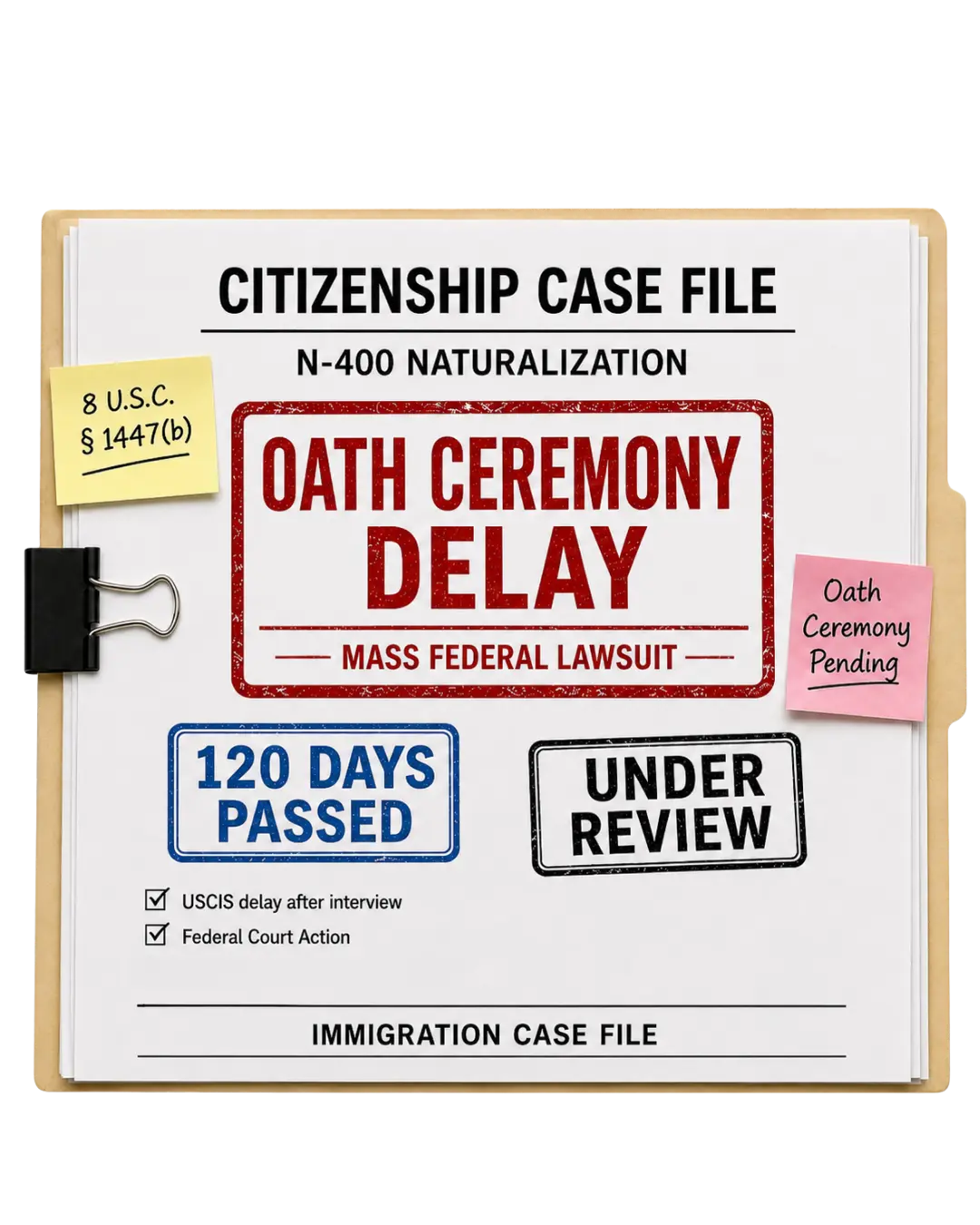
Right now we are building a Federal mass lawsuit for people whose Naturalization cases stopped dead after the interview. If you sat for your N-400 interview more than 120 days ago and USCIS has told you nothing since — no approval, no denial, no oath date — this post is about your case.
You passed the civics test. You passed the English test. The officer was pleasant. Then you walked out holding a form that says a decision cannot yet be made, and the silence began.
Months later, still nothing. Your green card creeps toward its expiration date. An election passes without you. Your parents keep waiting on a petition only a citizen can file. And no one at USCIS is obligated to explain why.
USCIS Has 120 Days. A Backlog Is Not an Exception.
Federal law is specific about this. Under 8 U.S.C. § 1447(b), once USCIS examines you on your naturalization application — that examination is your interview — the agency has 120 days to grant it or deny it. When that deadline passes with no decision, the law lets you ask the Federal District Court where you live to take the case. We explain the mechanism in our guide to enforcing the 120-day rule.
What the statute does not do is work on its own. Nothing happens automatically on day 121. The deadline only matters if someone brings it to a judge.
What We Are Asking a Federal Judge to Do
The complaint names USCIS and the U.S. Government, and asks the U.S. District Court for the Central District of California to do three things:
 Take jurisdiction over your long-delayed application, so the case sits with a judge instead of in a queue.
Decide your application, or order USCIS to decide it promptly — the statute allows either one.
End the unreasonable delay in your individual case, with a date attached to it.
Who Qualifies for This Naturalization Delay Lawsuit
The eligibility rules are strict on purpose — a group complaint is only as strong as the claims inside it. All four of these must be true:
➢ Pending Form N-400. Your Application for Naturalization is still pending with USCIS.
➢ Interview completed. You have already attended your Naturalization interview.
➢ More than 120 days of silence. USCIS has issued no decision since that
interview.
➢ Residence in the Central District of California — Los Angeles, Orange, Riverside, San Bernardino, San Luis Obispo, Santa Barbara or Ventura County. The case has to be filed where you live.
And reading this next list now saves you a disappointment later. This lawsuit is not for:
 Applicants who have not yet interviewed, or whose 120 days have not passed. The clock starts at the examination, not at filing.
Applicants who already received a decision, whether an approval or a denial.
Anyone outside those seven counties, or anyone currently in removal proceedings.
How a Mass Lawsuit Actually Works
Instead of filing one lawsuit per person, we group everyone with the same legal claim into a single federal case. Strategy, drafting and Court appearances happen once, for the whole group — that is what makes going up against the Federal Government affordable.
It also changes how the representation feels, and you should know that before you sign anything:
➢ You are named as a Plaintiff, because you are the person the delay is
happening to.
➢ Updates come through group communications — group emails and, when useful, group video calls.
➢ One-on-one calls with the attorney are not part of this case. Individual strategy is separate representation.
🟢 One flat fee, listed on the lawsuit page with exactly what it covers and what it does not.
After filing, the Government is served and typically has up to 60 days to respond. There is no set timeline beyond that. Many delay cases resolve because USCIS finally issues a decision rather than through a full trial — but the schedule belongs to the Court, not to us.
What We Hope For — and What We Will Never Promise
There are no guarantees of any outcome. The goal is to get a decision on your application, not to force an approval. USCIS still reviews whether you meet every requirement, and a decision can go either way.
🔴 A decision can be an approval or a denial. Anyone promising you citizenship is selling you something.
You should also know what the Government will argue. Their position is usually that your examination is not complete — background checks are still pending — so the 120-day clock never started. Ours is that the interview triggered it and the court has authority to resolve the delay. That argument is real, and it is the heart of these cases.
In our complaint we ask the Court to decide your application itself. In practice, the most common outcome is a remand to USCIS with instructions to decide within a set period. That is still a result: a file that had no deadline now has one.
The goal is not a promise. The goal is a deadline — set by a judge instead of by a backlog.
What Joining This Lawsuit Includes
The flat fee covers the case from the first draft to the last filing:
 Writing and filing the Complaint in Federal District Court.
Serving the Government — the formal notice that starts their response clock.
Routine communication with the Court and opposing counsel throughout the case.
Negotiating with the Government's attorneys, which is where many of these delays break loose.
Asking the Court to decide your case or order USCIS to decide it, and closing the lawsuit out.
What it does not cover: one-on-one attorney calls, appeals, a new or continued USCIS interview, responses to an RFE or NOID, other immigration filings, extra motions, and court hearings. This case challenges the delay — it does not take over your whole immigration file.
Once the complaint is finalized and filed, no additional plaintiffs can be added. Submissions close September 18, 2026 at 6:00 p.m. Pacific.
You Are Not Alone in This
If you have been refreshing your case status for months, you are not imagining how strange this is. People passed the same tests you passed and are sitting in the same silence — some for seven months, some longer, some who had an oath date and watched it get canceled days before.
A lot of them quietly give up and keep renewing the green card instead. You do not have to be one of them.
See If You Qualify
The fastest way to know where you stand is the eligibility form on the lawsuit page. It takes a couple of minutes, and our team reviews every submission. If you do not qualify, we will tell you — before you pay anything.
Don't wait on this one. The filing window closes September 18.

 Call us: (213) 262-2000
 WhatsApp: https://wa.me/17744265784
Frequently Asked Questions
Yes. Under 8 U.S.C. § 1447(b), once USCIS has interviewed you on your N-400, it has 120 days to grant or deny your application. If that deadline passed with no decision, the statute lets you ask the Federal District Court where you live to step in. You are not asking for a favor — you are asking a Court to enforce a deadline Congress wrote.
This post is general information about a federal lawsuit and is not legal advice
Posted in: Blog, Citizenship, Litigation News, Naturalization