

The New Aggravated Felony Green Card Bar: Why September 17, 2026 Is the Only Date That Matters

On Thursday, September 17, 2026, the Board of Immigration Appeals (“BIA”) threw out a rule that had quietly protected immigrants with criminal records for 26 years. If you are applying for a green card and you have an aggravated felony conviction, one thing decides whether it reaches you: the date on your plea paperwork.
Here is the part almost nobody is saying out loud. The Board applied its new rule going forward only. A conviction that already exists is not covered. A plea signed next month is.
The Rule That Protected You for 26 Years Just Fell
Back in 2000, in a case called Matter of Kanga, the Board read a rarely used line in the law — Section 212(a)(8)(A), which makes anyone “permanently ineligible to citizenship” inadmissible — the way its history suggested: it covered draft evaders, not people with criminal convictions.
In Matter of A-V-O-, a three-member panel reversed that. The reasoning is a chain, and every link was already in the statute:
 An aggravated felony permanently blocks good moral character. Section 101(f)(8), with no time limit attached.
No good moral character means no naturalization. Section 316(a) requires it.
Someone who can never naturalize is “permanently ineligible to citizenship.” That is the definition in Section 101(a)(19).
And that makes them inadmissible. Section 212(a)(8)(A) closes the loop.
The result is a second ground of inadmissibility stacked on top of the crime grounds these applicants already face.
Your Old Conviction Is Not What Changed
This is the part that matters most, and it sits at the very end of the opinion — where most coverage stops reading.
The Board limited the new rule to people convicted “based upon a plea of guilty or nolo contendere made, or a jury verdict entered, after the date of this decision.” Its reason was fairness: applying it backwards would upset what people reasonably expected when they resolved their criminal cases.
💡 Convicted before September 17, 2026? The old Kanga rule still governs. This ground does not attach to you.
💡 Plea or jury verdict after that date? You fall under the new rule.
💡 The trigger is the conviction date, not your filing date. Applying in 2027 on a 2019 conviction does not pull you in.
🔴 If your criminal case is still open, the date you sign a plea is now an immigration decision.
Why This Bar Is Harder to Undo Than the One You've Heard About
Most crime-based inadmissibility has a release valve: the Section 212(h) waiver. It is hard to win — it takes proof of extreme hardship to a close U.S. citizen or resident relative, plus a judge’s discretion — but it exists.
Read the text of 212(h) and you can see which grounds it reaches: specific subparagraphs of Section 212(a)(2), the crime grounds. Section 212(a)(8)(A) is not on that list.
 A 212(h) waiver may no longer be enough on its own for a conviction entered after September 17, 2026. It can clear the crime ground and leave this one standing.
“Aggravated felony” is an immigration label, not a criminal charge. Theft with a one-year sentence, or fraud over $10,000, can land inside it — even when the state calls it a misdemeanor.
This is a Board decision, not the last word. Federal appeals courts can review this reading.
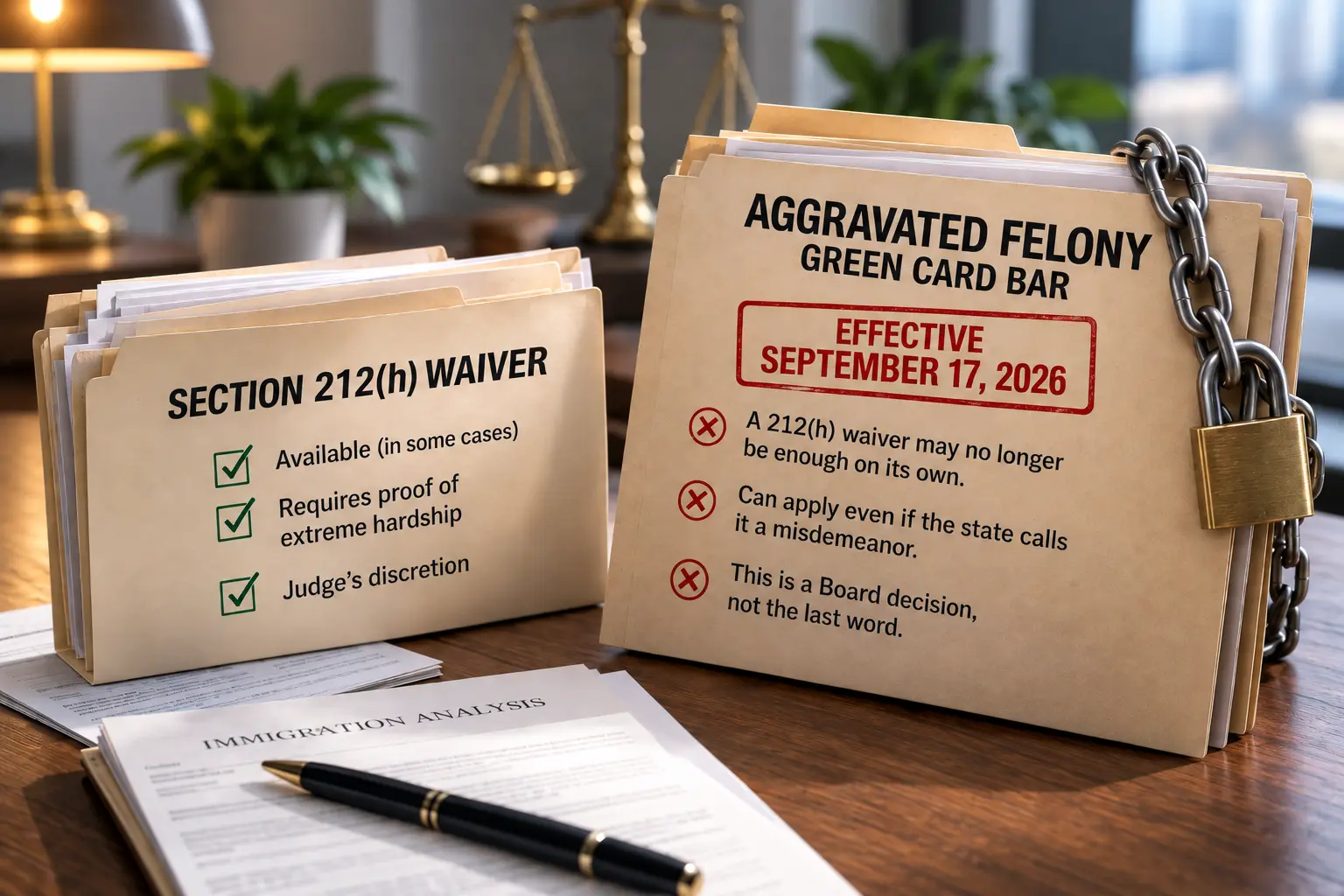
FOR CONVICTIONS ENTERED AFTER SEPTEMBER 17, 2026, THE USUAL WAIVER MAY NOT REACH THIS GROUND.
How Goldstein Immigration Lawyers Protects Your Future
We are reading this decision the way a defense attorney reads a calendar.
✅ We check the conviction date first. Which side of September 17, 2026 your case falls on reshapes everything that follows.
✅ We talk to your criminal defense attorney before a plea is entered. Charge selection, sentence length and timing are immigration decisions now.
✅ We map every ground, not only the obvious one. A case can survive the crime ground and fail on one nobody screened for — and different routes to a green card carry different waiver rules.
✅ We preserve the argument for review. Where the new rule applies, we build the record for the federal courts of appeals instead of conceding the point below.
You Are Not Alone in This
If you have been carrying an old conviction for years and a headline just made your stomach drop — read the date again. It very likely does not reach you.
And if your criminal case is open right now, you still hold the most valuable thing an immigration case can have: time. People do get through this. Not everyone, and not by luck — the ones who do got the immigration analysis done before the criminal case closed.
Bring us your conviction records, your charging documents, or the plea your criminal attorney is proposing. You will leave knowing which rule applies to you and what can be done about it.
 Call us: (213) 262-2000
 WhatsApp: https://wa.me/17744265784
Frequently Asked Questions
Not under this decision. The Board limited the new rule to pleas made, or jury verdicts entered, after September 17, 2026. An older conviction is still governed by Matter of Kanga. It can still cause problems on other grounds — it just does not trigger this one.
This post is general information about a Board of Immigration Appeals decision and is not legal advice. Reading it does not create an attorney-client relationship. Whether this rule reaches your case depends on your conviction date and your route to a green card, and that needs an attorney reading your file.
Posted in: Blog, Criminal Immigration, Green Card, Immigration News