

Not Just Any Visa. The Right Visa. A Complete Guide to U.S. Work Visas for Skilled Professionals and Exceptional Talent
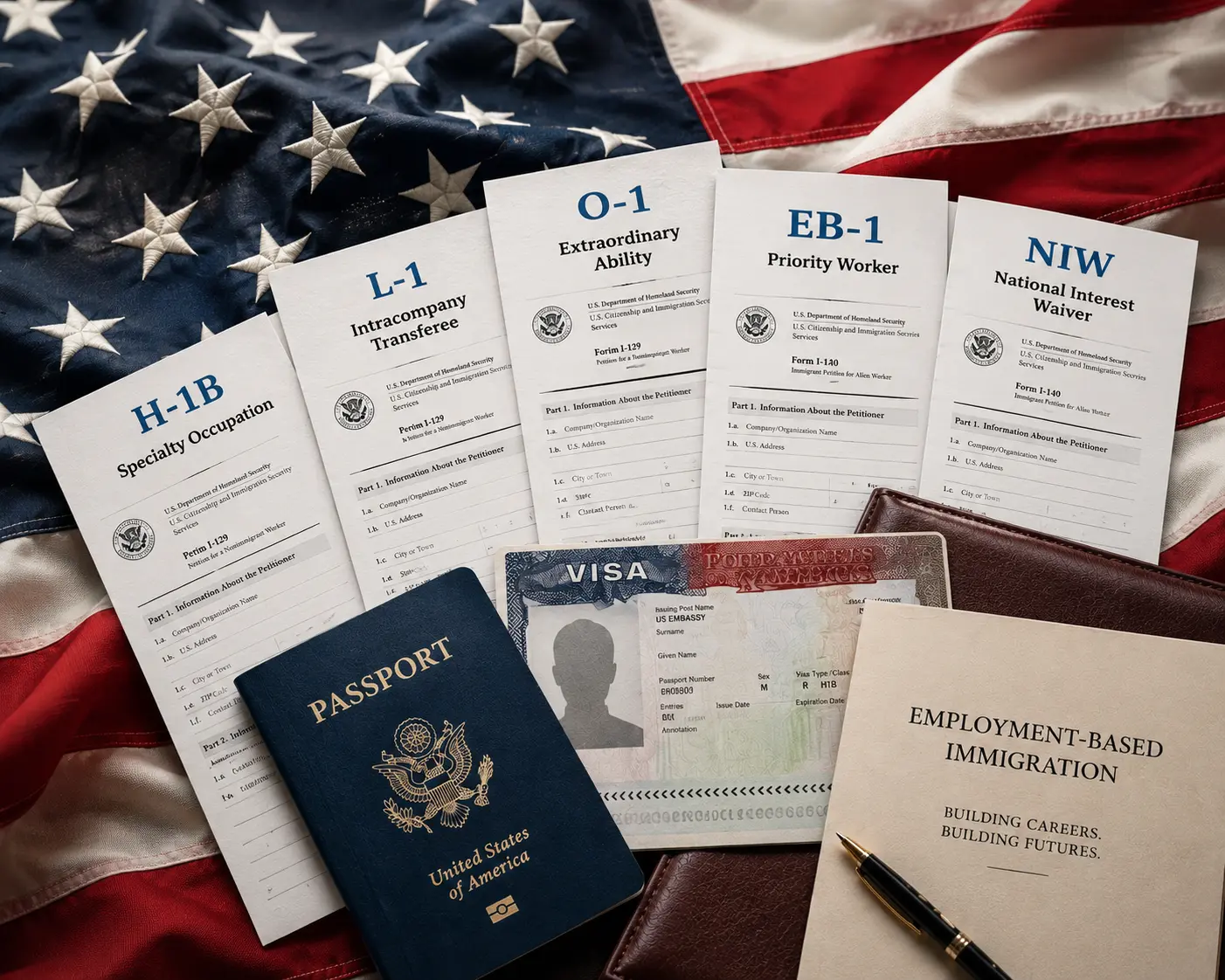
The U.S. Immigration System Is Not One-Size-Fits-All - And Neither Is Our Firm
At Goldstein Immigration Lawyers, we specialize in high skilled professional immigration. We work with engineers, scientists, executives, artists, academics, and entrepreneurs. The U.S. immigration system is broad by design - it serves farmers and field workers, seasonal industries, and multinational corporations alike. Every category exists because every type of work has value.
Our focus, by choice, is on a specific corner of that system: the employment-based pathways built for professionals, innovators, researchers, and exceptional talents who are shaping industries and building companies. That is where our expertise lives, and that is where we put all of it.
This is not a limitation. It is a commitment to doing one thing exceptionally well.
If you are a skilled professional wondering which U.S. work visa is right for your career - or if you are an employer trying to bring top-tier international talent onto your team - this guide is built for you.
First, an Important Distinction: Skilled Immigration vs. Seasonal Labor
Before diving into the visa categories, it is worth addressing a question we hear often: "What is the difference between the visas you handle and the ones you don't?"
The U.S. immigration system broadly separates employment-based visas into two worlds:
Temporary labor visas (such as H-2A for agricultural workers and H-2B for non-agricultural seasonal workers) are designed to fill short-term, lower-wage workforce needs in industries like farming, hospitality, and construction. They are transactional by nature - tied to a season, a project, or a temporary shortage.
Skilled and professional visas are designed for individuals whose contributions to a U.S. employer - or to the United States as a whole - are driven by specialized knowledge, advanced education, executive leadership, or extraordinary ability. These pathways are built for careers, not just jobs.
The distinction matters because the legal standards, documentation requirements, evidentiary burdens, and long-term immigration implications are fundamentally different. Doing one well does not mean doing the other well. Our firm has chosen depth over breadth - and our clients's outcomes reflect that.
Our Visa Portfolio: The Pathways We Navigate Every Day
H-1B - The Specialty Occupation Visa
Best for: Professionals in roles requiring at minimum a bachelor's degree in a specific, directly-related field.
The H-1B is the cornerstone of professional employment-based immigration in the United States. It is designed for workers in specialty occupations - roles where theoretical and practical application of highly specialized knowledge is required, and where a bachelor's degree (or equivalent) in a specific discipline is the standard entry requirement.
Common H-1B fields include technology, engineering, finance, accounting, architecture, medicine, law, consulting, and research.
Key features:
 Initial period of 3 years, extendable to 6 years.
Employer-sponsored - your U.S. employer files the petition on your behalf
Subject to an annual cap of 65,000 (plus 20,000 for U.S. master's degree holders), with selection by lottery.
Cap-exempt options exist for certain employers (universities, nonprofits, government research organizations).
The H-1B requires careful, well-documented petition preparation. USCIS scrutinizes specialty occupation claims closely, and a weak petition, no matter how qualified the applicant, is a petition at risk.
L-1 - The Intracompany Transfer Visa
Best for: Managers, executives, and specialized knowledge employees transferring within a multinational company.
The L-1 visa is designed for companies that need to move key talent across borders. If a multinational organization wants to transfer an employee from one of its foreign offices to a U.S. affiliate, subsidiary, or parent company, the L-1 is the vehicle to do it.
There are two subcategories:
L-1A - for managers and executives. Individuals who direct an organization, a department, or a function, and who supervise other professional employees or manage an essential function at a high level.
L-1B - for employees with specialized knowledge. Individuals who possess advanced, proprietary knowledge of the company's products, services, research, systems, or procedures that are not easily transferable to another employee.
Key features:
Does not require a university degree - the focus is on the nature of the role and the individual's relationship to the company
Requires the employee to have worked for the company abroad for at least one continuous year within the past three years
Initial period of 3 years (1 year for new offices), extendable up to 7 years for L-1A and 5 years for L-1B
No annual cap - not subject to lottery
L-1A holders have a streamlined path to permanent residence through the EB-1C Green Card category
The L-1 is a powerful tool for multinational companies building their U.S. operations - and for executives and specialized professionals who want a direct, cap-exempt route to working in America.
O-1 - The Extraordinary Ability Visa
Best for: Individuals who have reached the top of their field in science, education, business,
athletics, or the arts.
The O-1 visa is reserved for individuals who are not just good at what they do - they are among the best in the world at it. It is an acknowledgment by the U.S. government that certain individuals possess a level of achievement and recognition that sets them apart from their peers in a measurable, documented way.
There are two subcategories:
O-1A - for individuals with extraordinary ability in science, education, business, or athletics. Think: leading researchers, award-winning academics, C-suite executives with nationally recognized achievement, world-class athletes.
O-1B - for individuals with extraordinary achievement in the arts, film, or television. Think: internationally recognized musicians, acclaimed directors, Emmy or Grammy nominees, celebrated performers.
Key features:
No annual cap - not subject to lottery
Initial period of up to 3 years, with 1-year extensions available indefinitely
Requires substantial documentary evidence of extraordinary achievement - awards, publications, media coverage, critical roles, high salary relative to peers, and more
Employer or agent-sponsored
The O-1 is not for everyone - but for those who qualify, it is one of the most powerful nonimmigrant visa categories available. It also pairs naturally with a path toward the EB-1A Green Card for permanent residence.
EB-1 - The First-Preference Employment Green Card
Best for: Individuals with extraordinary ability, outstanding professors and researchers, and multinational executives and managers seeking permanent residence.
The EB-1 is the gold standard of employment based Green Cards. It sits at the top of the preference system, which means shorter wait times - often significantly shorter - compared to other employment-based Green Card categories.
The EB-1 has three subcategories:
EB-1A - Extraordinary Ability: For individuals who have demonstrated sustained national or international acclaim in their field through extensive documentation. Critically, this category does not require an employer sponsor -extraordinary individuals can self-petition.
EB-1B - Outstanding Professors and Researchers: For individuals recognized internationally as outstanding in their academic field, with at least three years of experience in teaching or research, seeking a tenured or tenure-track position or comparable research role.
EB-1C - Multinational Executives and Managers: For executives and managers who have been employed abroad by a multinational company for at least one year and are being transferred to a U.S. affiliate, subsidiary, or parent in a managerial or executive capacity. This is the natural Green Card pathway for L-1A visa holders.
Key features:
No labor certification (PERM) required - faster path to permanent residence
EB-1A allows self-petition - no employer needed
Priority dates are often current or very close to current for most nationalities
Sets the foundation for U.S. citizenship eligibility down the road
EB-2 and the National Interest Waiver (NIW) - The Green Card for
Professionals and Game-Changers
Best for: Professionals holding advanced degrees and individuals whose work serves the national interest of the United States.
The EB-2 category is designed for professionals with advanced degrees (a master's degree or higher, or a bachelor's degree plus five years of progressive experience) or individuals with exceptional ability in science, arts, or business.
It requires an employer to sponsor you and complete a lengthy labor certification process known as PERM - proving to the Department of Labor that no qualified U.S. worker is available for your role. This requirement alone can add months or even years to the process, and not every professional has an employer willing or able to go through it.
Within the EB-2 category sits one of the most strategically powerful tools in employment-based immigration: the National Interest Waiver (NIW). With the NIW, you skip the lengthy labor certification process known as PERM entirely.
To qualify for a National Interest Waiver, you must demonstrate that:
 Your proposed work has substantial merit and national importance;
 You are well-positioned to advance that proposed work; and
 On balance, it would be beneficial to the United States to waive the job offer and labor certification requirements.
This standard - established by the landmark Matter of Dhanasar decision - has opened the NIW pathway to a wide range of professionals: researchers advancing public health, engineers developing critical infrastructure, entrepreneurs building innovative companies, educators improving underserved communities, and many more.
Key features:
Self-petition available - no employer sponsor required
No PERM labor certification required
Broad applicability across fields with genuine national impact
A particularly strong option for researchers, academics, scientists, and high-impact entrepreneurs
Which Pathway Is Right for You?
Choosing the right visa or Green Card strategy is not a decision to make based on a checklist. It depends on your field, your qualifications, your career goals, your employer's situation, and - critically - the current state of immigration processing and policy.
Here is a simplified starting framework:
 You have a U.S. job offer in a specialty occupation → Start with the H-1B
You are being transferred by your multinational employer → Explore the L-1
You have reached the top of your field and can document it → Consider the O-1 and a path toward EB-1A
Your employer wants to sponsor your Green Card directly → Look at EB-1B, EB-1C, or EB-2
Your work serves the national interest and you want to self petition → The EB-2 NIW may be your strongest move
These pathways are not mutually exclusive. Many of our clients move through multiple visa categories on their journey to permanent residence - and ultimately, citizenship. A well-built immigration strategy accounts for the full arc of your career in the United States, not just the next step.
Why the Right Legal Partner Makes All the Difference
Employment-based immigration is not a form-filing exercise. Every petition is a legal argument - a structured, evidence-backed case that your qualifications meet a specific legal standard. USCIS officers review thousands of petitions. The ones that succeed are the ones that are clearly, compellingly, and completely documented.
A poorly prepared H-1B petition can result in a Request for Evidence that delays your start date by months. A weak O-1 argument can lead to a denial that follows your immigration record. An EB-2 NIW that does not properly frame your national interest contribution will fail - regardless of how brilliant your work actually is.
At Goldstein Immigration Lawyers, we do not take shortcuts, and we do not do volume work. We build cases. We craft arguments. We know the standards, the adjudicators, and the evidentiary landscape - and we use that knowledge to give your petition the strongest possible foundation.

Let's Build Your U.S. Immigration Strategy

Whether you are a professional exploring your first work visa, an executive navigating an international transfer, or an extraordinary talent ready to plant roots in the United States permanently - we are ready to work with you.
 Identify the right visa or Green Card pathway for your specific situation
Build a legal strategy that accounts for your long-term career goals
File a petition that is precise, well-documented, and built to win
 Call us: (213) 262-2000
 Visit: www.jgoldlaw.com
Frequently Asked Questions
A nonimmigrant work visa (such as the H-1B, L-1, or O-1) allows you to live and work in the United States temporarily, tied to a specific employer and purpose. An employment-based Green Card (such as EB-1 or EB-2) grants you lawful permanent residence - the right to live and work anywhere in the United States indefinitely, without being tied to a specific employer (in most cases).
Posted in: Blog, Employment-Based Immigration