

Employment Authorization Document (EAD) vs. Employment-Based Visas: Don’t Fall Into the 2026 Status Trap
The High Stakes of "Working Legally" in 2026
For many immigrants, the primary objective is straightforward: "I wish to pursue employment." However, within the United States legal framework, the specific mechanism used to obtain that authorization is of greater significance than the authorization itself.
Confusing an Employment Authorization Document (EAD) with an Employment-Based Visa is one of the most dangerous mistakes you can make right now. With USCIS tightening security and shortening document validity, relying on the wrong category could leave you without a job and without a legal way to stay in the country.

The Employment Authorization Document (EAD) : A Temporary "Accessory"
An EAD (Form I-765) is an accessory to a primary application.
Consider the context of a family-based adjustment of status: An applicant may seek residency through a qualifying relative. Given that processing timelines can be extensive, USCIS may grant work authorization to provide the applicant with legal means of support while the underlying petition remains under adjudication.
 The Catch: If your primary case (asylum, marriage, etc.) is denied or even just placed on a long "vetting hold," your EAD is often at risk.
The 2026 Reality: As of late 2025 and early 2026, USCIS has reduced the maximum validity of many EADs to 18 months. This means you are now forced into more frequent security checks and higher filing costs just to keep your job.
This new change primarily impacts individuals with pending Adjustment of Status applications; pending asylum or withholding of removal matters; refugees; asylees; and recipients of withholding of removal.
The reduced validity also impacts TPS holders and applicants, along with parolees and those that are paroled into the United States as refugees, with the reduced validity of an EAD to 12 months, or the end of their authorized period, whichever is shorter.
Lastly, there are no longer automatic extensions for renewal applicants. Applicants must now wait for renewal to be fully approved before they can continue working after their current EAD’s expiration.
Employment-Based Visas: The "Master Key"
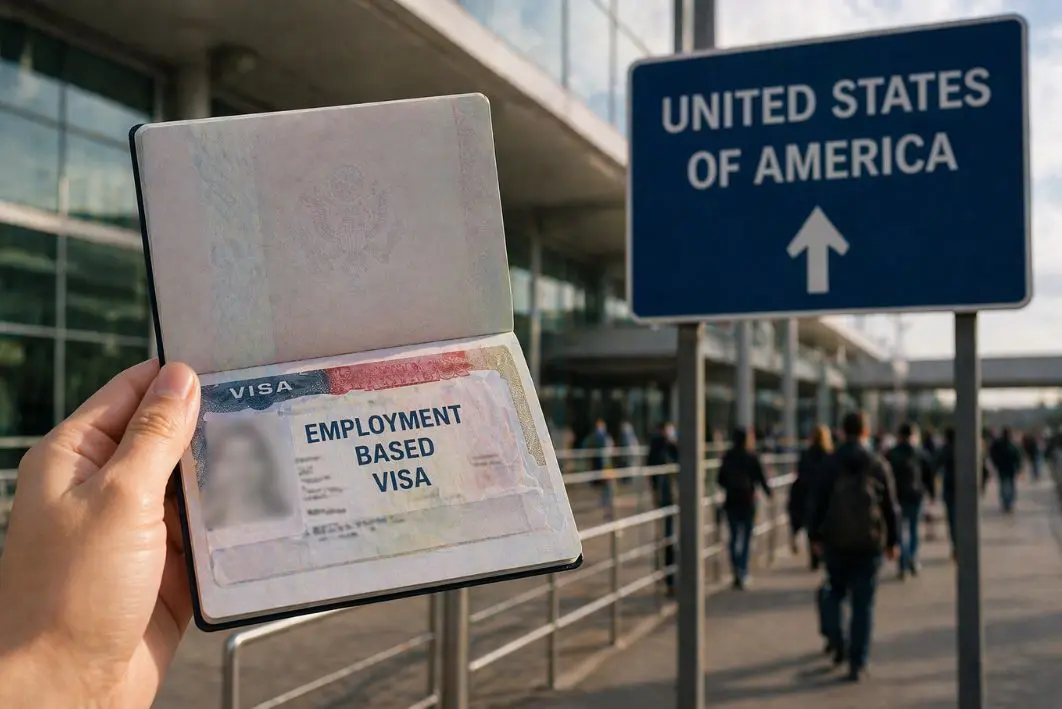
Unlike the EAD, an Employment-Based Visa (such as EB-1, EB-2 NIW, O-1, or L-1) is a primary petition. In this scenario, your skills are the reason you are here.
 Inherent Authority: For many of these visas, your legal status and your work authorization are the same thing. You aren't "waiting" for a permit to survive; you are in the U.S. because of your professional contribution.
Stability: Employment visas like the EB-2 NIW (National Interest Waiver) lead directly to a Green Card. They don't depend on a humanitarian claim or a family member, they depend on your credentials.
Why You Should "Pivot" to an Employment Visa in 2026
Relying on an EAD linked to a pending asylum or family case is like building a house on a foundation you don't own. Here is why our department of employment-based visas is seeing a surge in "pivots":
1. Eliminate the "Middleman": In 2026, "Extreme Vetting" means that humanitarian cases are facing massive backlogs. An EB-2 NIW allows you to self-petition and take control of your own timeline.
2. Continuous Status: If you have an O-1 or H-1B, you have a solid "Non-Immigrant" status that is often much easier to defend than a "Pending" status.
3. Avoid EAD Gaps: With the end of many automatic 540-day extensions, many workers are losing their jobs because their EAD renewal didn't arrive in time. A primary employment visa provides a more stable legal framework.
The "Dual Tracking" Strategy
In 2026, we recommend "Dual Tracking." This means you might have an EAD through one case (like a pending family petition), but you also file an EB-2 NIW or O-1.
Why? Because if your EAD-based case hits a wall, your employment-based
petition serves as your "Plan B" (or your "Master Plan") to stay in the U.S. legally.
Don’t Wait for Your Work Permit to Expire
If you are currently working on an EAD and you have a professional degree or extraordinary skills, you are in a position of strength. But that strength only lasts as long as your documents are valid.
At Goldstein Immigration Lawyers, we help you:
 Audit your profile to see if you qualify for an EB-1, EB-2 NIW, or O-1.
Draft a strategy that moves you away from "accessory" permits and into a primary, merit-based status.
Protect your career from the sudden 2026 policy shifts.
Take the Next Step
Your career and your family’s future should not depend on a temporary "accessory." Let's build a primary path for you.
Call (213) 262-2000 | Visit www.jgoldlaw.com
FAQ: Employment Authorization Document (EAD) vs. Employment-Based Visas
No. An EAD is a document that gives you permission to work while a separate immigration case is pending. A visa (like O-1 or H-1B) is a legal status that usually includes work authorization.
Posted in: Blog, Immigration News